Saturday, March 28, 2020

The End Of Familiarity (Tradecraft)

When you walk into my store and look to the right, the designated direction Americans gaze when entering a store, you'll find a plethora of familiar game titles. Monopoly, Yahtzee, Scrabble, all the usual suspects. This is what is known as a "merchandising expense," games I stock that I would rather not, that indicate to the uninitiated that I am a safe place with things they are familiar with. This is a game store with games, you know, game games, as one customer recently described it. This practice is now coming to an end.

Here's how that works. First, hobby games have penetrated the mass market and they've been there now for a good, long time. Unless you're living under a rock, if you've been to Target and WalMart in the last decade and care even an inkling about games, enough to roll your red or blue cart past them, you've seen Settlers of Catan, Ticket to Ride, Carcassonne and other former hobby game store exclusive titles.

These titles have declined for us significantly since their introduction in mass market, with the promise they are gateways to good times for us later. Perhaps this is true, perhaps not, but board games are booming. These titles are now familiar to consumers. They've become evergreens on the shelf of mass market stores. This means hobby game stores don't need to work as hard with our garbage merchandising expenses to show familiarity. Chess sets and Hasborg products can be dropped, if you feel your community have these touchstones in their lives. And what community doesn't?

Second, even if I don't have this market penetration that breeds familiarity, there are now enough regular folks who play hobby games to where I need the space taken up by oversized merchandising inventory. I may lose the completely out of touch customer, but my overall base is so much larger than a decade ago, I can afford it. What I can't afford to do is stock quaint product for muggles when I've got educated consumers flocking to my business and demanding games now. They will just as easily, and without a moment of regret, buy it online, so it better be there now.

In general, if you don't know or are frightened by products like Dungeons & Dragons, Ticket to Ride, Pokemon and Magic: The Gathering, you are simply not worth any of my time whatsoever. Through mass market stores and the Internet, the public has been converted from suspects to prospects. In fact, it has turned many from prospects to customers, bypassing hobby game stores completely. I am at the tail end of this equation, taking in what I can of a cultural shift, in which a hurricane of customers have been created and I'm trying to fill up a thimble, arm outstretched into the clouds, while dying of thirst. As with all revolutions, you never know exactly your place in it until shots are fired.

Games in my parents guest room. One of these things is not like the other.

Steak, Not Hamburger

"Still Life - 1901" by Pablo Picasso. Art used for criticism under "Fair Use."


I've been told that the image of an average American in Spain is of someone at a baseball game with a hot dog in one hand and a Coke in the other. If this is the case, then I'm no an average American. Hot dogs taste about as terrible as they look, like boiled phalluses (circumcised, clearly). Now, now, I certainly give credit to the, uh, "genius" who figured out how to sell unwanted animal parts by wrapping them up into something Linda Lovelace would swallow. Just forgive me if I resist the impulse to deep-throat wieners every summer. Coca-Cola, on the other hand, resembles battery acid in both appearance as well as tooth decay. The taste is hardly worth getting excited about as far as sodas go. More or less Pepsi under another name. Perhaps if they put the cocaine back in, I'd be more inclined to hold a favorable opinion. Some might argue that this first paragraph could disqualify me from American citizenship. Though I'd argue that it would disqualify me from most Memorial Day barbecues.


It should come as no surprise that I don't have much a taste for hamburgers. It seems that the only American meats my stomach can stomach are steak, pork, and chicken (though even the chicken can elicit occasional bouts of diarrhea). So it goes without saying that hamburgers were among the last things I expected to eat in Spain. Imagine my surprise, then, when I heartily chowed one down for lunch and begged my host mother for seconds.

Truth be told, I didn't know it was a hamburger at first. I often didn't know what kinds of meats went into my sandwiches. Being that I would be living in someone else's home for two months, I avoided being picky about the food. I didn't expect to run into too much trouble here, since I'm an American, and Americans can eat just about anything provided it's properly salted. The Spanish sandwiches I had been used to thus far were either ham, turkey, egg, or pig liver. The latter being among my favorites, if not a tad oily. The hamburger smelled like steak, and tasted about the same, too. When I lauded my host mother for her cooking skills, she revealed the secret identity of my meal. Morgan Le Fey seduced King Arthur by disguising herself as Guinevere, and so too did my nemesis, the hamburger, trick me with false vestments. I'm not an expert on meats, so I couldn't tell you if burgers are prepared differently in Spain than in the United States. I just know that it tasted a hell of a lot better. Speaking of hamburgers, I went to a Spanish McDonald's. To my disappointment, it tasted exactly the same as its American counterpart. Probably about as unhealthy, too.

My host mother was a very skilled cook, I daresay she rivaled my own mother. (And that's saying something!) She made delectable fried potatoes, green peas with ham, tomate y pan, cream of zucchini, fresh clams with rice, and that cold tomato soup, gazpacho. I noticed that the Spanish diet includes a lot of eggs, for every meal and in every dish. Nowhere is this better seen than with the Spanish tortilla. In America, the popular conception of a "tortilla" comes from Mexico, which is a flatbread of ground wheat flour. In Spain, the "tortilla" is a bit closer to an omelet, with some major exceptions. The Spanish tortilla can be produced in any frying pan, it requires a mix of eggs, potatoes, onions, and oil. One can add vegetables or meats at their own pleasure. The closest thing I had had to a Spanish tortilla in the States is quiche. Though I'd venture that the tortilla tastes plenty better, especially with ketchup or salsa.

I also tried my tongue on the foods outside of my home, of course. During a brief festival in Santander, I had the good fortune of eating chorizo and paella. As I write this, I am learning that chorizo is a type of sausage, but it certainly didn't taste like one. (Tongue is not as reliable as I once believed it to be.) The chorizo meat was chopped up and mixed with fries and an egg sunny-side up. Quite spicy, though an attractive snack. Paella, on the other hand, was a savory display of Santander's seafood. Being that the city was by the sea, I'm surprised I didn't come across more seafood, but I won't linger on that. Paella is primarily a rice dish, but mixed in with whatever else is available. I can recall fish and shrimp in the paella I had, but beyond that, it's a blur.

When going to another country, it's a cardinal sin not to try the ice cream. As expected, they have all the common flavors, vanilla, chocolate, strawberry, etc. I first tried out turron, a flavor exclusive to Spain, since it is based on a treat they have during Christmastime. I'll admit, I've never had turron before, but I found that the novelty of turron ice cream wore off and devolved into blandness. I fell in love with lemon, being partial to lemon flavored everything since birth. Though pineapple comes in a close second, it doesn't quite melt into the tongue the way that lemon can. I also got a chance to try out Italian gellato at a shop adorned with photos of my high school muse, Audrey Hepburn (fresh off of the film Roman Holiday). You could have two flavors on your cone, I chose chocolate chip mint and some coffee variant. Then there was the frozen yogurt, which was beyond any cream I had ever tasted in my life. This may sound contradictory, but it had a sourful-sweetness to it.

In Spain, the laws surrounding alcohol are far more lax than those in the States. People under twenty-one can drink their fill and without the pestering need to reveal their ID. There are probably cultural differences to these matters, as Spaniards drink alongside their meals and for social relaxation. Americans drink to get drunk. Though these are crude generalizations, as I'm sure there's many a drunkard in Spain as there is a connoisseur in the States. Yet in Spain, one can sense that society feels a touch more comfortable with alcohol in the streets. I literally drank all night with some friends outside of a church. I think that this comfort can be attributable, in part, to the decreased emphasis on driving in Spain. Most folks in the Iberian Peninsula take buses, ride bicycles, or walk. So there's less a fear of drunk drivers causing mayhem on the roads, and I should add that drunk driving accidents are still a leading killer in the States. I've long bemoaned to myself that the American "drink-until-you-get-wasted" ethic, has spoiled many an opportunity to craft a better relationship with alcohol.

While not exactly a drinker, I wasn't exactly a greenhorn, either. I had tasted wine before in my childhood as a Catholic. We took of it during the communion ritual, in which we believed that during "transubstantiation", the wine was briefly transformed into the literal "blood of Christ." An odd, and frankly, unnerving practice when one really thinks about it. One that veers a tad too close to the dietary habits of one Count Dracula. It reminds me of a humorous scene in David Attenborough's Gandhi. While riding on a crowded train with the young Mahatma, Rev. Charlie Andrews encounters a Hindu who tells him that he knows a Christian woman who drinks blood every Sunday. Andrews appears rather disturbed to hear this, until the Hindu adds that this is the "blood of Christ." This detail relieves him slightly, though the initial shock of the conversation does not seem to have left him. Heavy stuff, too heavy for me. So I started off simple. I drank beer.

Beer was the blood of Homer Simpson, the quintessential American beverage. You'd be forgiven for assuming that I'd fall into it naturally. You'd be forgiven, until seeing my track record with hamburgers and hot dogs. So it goes that America's favorite drink will garner no favor of mine. Beer certainly had an attractive smell, as does vanilla extract, but both are about as flavorless as the underside of my refrigerator. In a word, beer didn't cut it for me. There are variants of cat piss which would make more of an impression. So, seeking a more heightened experience, I went for the heavy stuff. The blood of Christ.

I can't put my tongue on it exactly, but red wine, or vino rioja, has a warm place in my heart. It seems that, like a good woman, red wine fills the body with warm elation, and daresay, presents a brief clarity of the mind. The blood of Christ. I can personally attest to these effects, having read the works of Haruki Murakami and Pope Francis while drinking the elixir in some bars and cafes. Murakami, I will say, felt a bit more of a comfortable choice to be reading in these places. His strange narratives often feature jazz bars of a sort. A motif that, no doubt, came from his experiences running the jazz bar, Peter Cat. The wine helped be absorb them. With each sip, my brain became more receptive to the words on the page, indeed, they flowed through me. Upon returning to the States, I have found this effect to be just as potent. Further, it not only made reading more enjoyable, but film and music as well. Of course, there were other drinks I had that are worth note: strawberry daiquiri, sangria, tinto de verano, and moscato. I have a little anecdote about old moscato. When in the Cafe Alaska, I ordered the moscato in Spanish, though the bartender seemed unfamiliar with it, so I repeated it again and again, but to no avail. It turns out that I had been saying the word mascota, which means pet. I half-expected Alf to come in as a waiter with a cat sandwich. We both had a good laugh after that.

And then I got drunk.

American poet, Ogden Nash, once said, "Candy is dandy, Liquor is quicker." It sure is. In my drunkenness I remembered the Porter from Macbeth who called alcohol a provoker of "nose-painting, sleep, and urine." Further, there was lechery, the Porter adds, "it provokes and unprovokes: it provokes the desire but takes away the performance. Therefore, drink may be said to be an equivocator of lechery: it makes him and mars him; it sets him on and takes him off; it persuades him and disheartens him, makes him stand to and not stand to, in conclusion, equivocates him in a sleep and, giving him the lie, leaves him." Forgive me, I quoted the passage in full, though the first sentence would've sufficed. In my defense, I just wanted to give the reader a colorful illustration of the contradictory and confusing nature of alcohol, though many are already well familiar. In my case, drunkenness was hardly an aphrodisiac, nor did it make my nose red, or my bladder go wild. It succeeded in, for good or for ill, liberating my id from the constraints of my superego. I grew less inclined to think before acting. There was something quite freeing in that, although it made keeping your balance tricky.

It was not my intention to get drunk, but then, that's what they all say, isn't it? I was fresh off of completing Bertrand Russell's Wisdom of the West, in which he spoke fondly of Socrates' self-control, "In all he did he was moderate and has amazing control over his body. Though he rarely took wine, when the occasion arose he could drink all his companions under the table without getting tipsy," (65). I thought at the time, perhaps out of sheer hubris, that I could exercise a similar restraint. I had also determined not to live up to American stereotypes, but rather, model an American founder, one Benjamin Franklin. In his Autobiography, Franklin has a list of thirteen virtues that essentially compromised his philosophical outlook. All the precepts are worth following, but what stuck out to me most was the first one, "Temperance", which states, "Eat not to dullness; drink not to elevation," (104). I tried to follow this edict, and for the most part I was able to, but somewhere along the way, I fell through. I'll try to be more careful with my liquor in the future, though these matters aren't always easy to anticipate. I don't expect them to be.

In my favorite anime, Neon Genesis Evangelion, one of the leading voice actors goes by the name of Spike Spencer. In addition to being an excellent voice actor, Spike is also an expert in dating and travel. While eating in Spain, I often thought back to something he a said about getting a "taste of culture",

"When you're goin' to different places, different countries, and tryin' different foods, that is the best! I always say that is where you taste, when you eat the local food of a place, you're tasting the soul of that place. Because if you think about this: when we move, when we populate an area, why do we populate that area, at any given time? Because that's where you can make food! You know, so whatever's there, in Japan and Asia there's so much rice, because that's kind of there. You don't see a lot of wheat fields. They have a lot of rice. What do we have? We have lots of fields, so we own wheat. So we own a lot of bread and stuff. And, I mean it's that kind of idea, I think food is such a great connector of people. I think it gets down to the very base level. So when you're sharing food with somebody, that you made for them, that's pretty sweet. It shows that you care a little bit more," (YouTube).

I had the privilege of tasting Spanish food, and so, a part of the Spanish soul. It is an opportunity that many do not have, including some who live on the Spanish soil itself. For in Spain, I saw poverty face-to-face. Homeless people sat on the sidewalks, some with small bowls out for collecting coins. I tried to give them what little change I had whenever I could. Though I couldn't always. What shocked me, however, is that whenever I gave, no matter how small the amount, these poor showed immense gratitude. They knew, more than I, what it was like to live without. They knew, better than I, the value of every euro. The euro is not simply a form of currency in the European Union, but a symbol of solidarity and prosperity. Ideals that were put into question by the ongoing economic crisis in Greece. Do these ideals still mean anything to the poor? I can't say.

The shame of inequality is what kept us in different steps of the economic ladder. I began to realize how much of what I am today can be attributed to my wealth. Being a college student, I clearly don't have much of it, but I have far more than they. It's an unfair circumstance, I know, and I have no answers on how to fix it. With what little change I gave, I knew I wouldn't heal their long-term poverty. Yet they still they were hungry. Hunger was an impulse that couldn't wait for economic reforms. My host mother packed me lunches. I gave them half. In the long run, it's a small token, but it beats an empty stomach. I don't where these poor people are today, or if their situations will ever improve. We were strangers then and we are strangers still, yet through the sharing of food, we connected, however briefly.

Through the sharing of food, I showed them, that I cared a little bit more.


Further Reading

"A Fear Of Flying They Call It." http://sansuthecat.blogspot.com/2015/09/a-fear-of-flying-they-call-it.html


Bibliography

Franklin, Benjamin. The Autobiography of Benjamin Franklin. Barnes & Noble Books: New York, 1994. p104. Print.

Russell, Bertrand. Wisdom of the West. Rathbone Books, Ltd: London, 1959. p65. Print.

Spencer, Spike. "A Taste Of Culture." YouTube. Web. https://www.youtube.com/watch?v=zLwL9oD1Zek


QA Gig At Adult Swim


Must be available to work full time, 40 hours per week
- Work with Production and Games Teams to create patch notes for launch cycles
- Test any new content/game launches to ensure that everything is working as intended
- Report defects and work with production, games team, and development to clarify and resolve any issues
- Guarantee that we are delivering the highest quality experience to our end users
Third Party Management
- Work with third party vendors, such as external testing vendors, to assist with on-going QA testing
- Create test plans
- Establish process for communicating any issues found
- Review all bugs that are reported and determine the validity of the bug

Those who are interested can send me an email with their resume to ryan.murray@turner.com.

Ready, Set, Go...

Monday, March 23, 2020

Game 362: OrbQuest (1981)

I'm playing the second edition of the game. The first is not available anywhere.
            
OrbQuest
United States
Alternate World Simulations
Released in 1981 for CP/M
Date Started: 10 March 2020
Date Finished: 15 March 2020
Total Hours: 25
Difficulty: Moderate-Hard (3.5/5)
Final Rating: (to come later)
Ranking at time of posting: (to come later)
       
Digital Research's CP/M operating system only boasted two original RPGs, and it turns out that both of them were adapted directly from games on the PLATO mainframe. A year ago, I covered how Nemesis (1981) was just a microcomputer version of Oubliette (1977), and now it's clear that OrbQuest is nothing more than a microcomputer version of The Game of Dungeons (1975), more popularly known by its file name, "DND." Specifically, it is a direct adaption of the game's fifth edition.
          
Finding a treasure chest in the OrbQuest dungeon offers the same options as The Game of Dungeons.
          
We've discussed at length how Daniel Lawrence based his own DND (c. 1976) on The Game of Dungeons, but OrbQuest is a far more literal porting of the code than Lawrence's. Indeed, if I'd known about it when I won The Game of Dungeons, I might have been content to discuss OrbQuest in an addendum rather than playing it as a separate game. Among the things it shares in common:
            
  • A goal to recover an Orb, held by a powerful guardian (a dragon in Game, a "dragon wizard" here)
  • Twenty 9 x 9 levels with the same system of movement (e.g., SHIFT to go through a door), secret doors, and one-way doors
  • No staircases, just "teleporters" that take you to the next and previous levels, and the teleporters are oddly spaced between squares rather than in them
  • The same attributes, with "piety" substituted for "wisdom" 
  • Experience based on monsters killed and gold retrieved
  • Most of the same spells, divided into cleric and mage, with slots given to the character upon leveling
  • The same combat options, including minimized importance of "fighting" and each enemy having a particular weakness to a particular spell
  • The same commands and results for opening chests, drinking potions, and reading books
  • Most of the same items of magical equipment to find
  • Most of the same monsters
  • On dungeon Level 1, monsters are never higher than Level 1 
  • Options to toggle on or off automatic collection of gold and automatic fighting of enemies below a certain level
        
I'm assuming that Dirk Pellet and the other Game authors didn't know about this attempt to monetize their work, or certainly they would have objected as strongly as they did to Lawrence's. Relative obscurity must have helped: OrbQuest appeared only for a dying platform, and the creator notes on a message board that he only ever sold about 100 copies.
           
The Game of Dungeons' cleric spells were, in contrast, "Light Candle," "Holy Water, "Exorcise," "Pray," "Hold," "Dispell," and "Datspell."
               
As to that creator, his name was Walter E. Donovan, and his company--existing only for this game, it seems--has an address in Milpitas, California. So far, I have not been able to tie Donovan directly to a PLATO campus (unlike Lawrence and the author of Nemesis), so I'm not sure how he was exposed to it, but it's clear that somehow he got the source code or otherwise thorough documentation of its elements and mechanics.
               
A nice cover leads the game manual, which is otherwise typewritten and photocopied.
           
As usual, this is not to say that Donovan added nothing to the game. In fact, he smoothed away some of Game's most egregious imbalances and made the game less random. Gold is less plentiful, particularly on earlier levels, chests (and thus magic items) rarer, and traps less deadly. A player can no longer spend half the game just wandering the same corridors of Level 1 and picking up nearly every magic item along the way. Chests have only about 10 times the gold as random loot on their levels, not 1000 times. Chests aren't trapped as often, and when they are, they rarely kill you unless you've delved too far too fast. Magic items are never trapped. Books and potions help more than they hurt, so it's worth taking the chance on them.
               
Potions and books are less deadly here than in the source game.
       
The result is a game that is, even with permadeath, far more survivable than The Game of Dungeons but also less "gameable." There aren't any tricks to help you get rich quick (unlike in Game, you can't cache gold, either) or otherwise bypass the long and tedious process of grinding yourself senseless for several dozen hours. I've been doing it while clearing out my Netflix queue, but I can't imagine that even back in the day, when it was the only game for my platform, I would have had a lot of fun with it.
             
Collecting gold to raise my level. I have a pretty good set of equipment here.
          
The game begins with random rolls of 3-18 for strength, dexterity, intelligence, and piety. After that, you begin on Level 1 of the dungeon. The 9 x 9 levels have a fixed layout but a random distribution of gold, chests, and other items, re-randomized every time you change levels or exit the dungeon. Encounters are completely random and also extremely variable. Sometimes, I walked 20 steps or more with no encounters; other times, I had three or four in the same square.
                
The limited character creation process.
            
For the most part, you meet the same monsters on all levels, but the monsters themselves have levels. The monster's level is far more important in determining his danger than the monster type; that is, a Level 3 ghoul is deadlier than a Level 1 dragon. On dungeon Level 1, monsters are never higher than Level 1 themselves. On other dungeon levels, their levels are randomized to a maximum of roughly 5 times the dungeon level for levels 1-10--unless you're carrying gold, in which case their maximum level is something like 4 times the dungeon level plus 1 for every 5,000-10,000 gold pieces you carry.
             
My maps of the first nine levels.
           
OrbQuest lacks the "excelsior transport" from Game, but several of the levels have pits that take you directly to lower levels. The levels have varied layouts with secret doors, one-way doors, and such, but no special encounters until Level 10. Playing the game is a process of exploring downward, picking up gold until you start to encounter monsters you can't handle, then hauling it back up to Level 1 and then exit in order to level up. The next time, you can go a little further and collect a little more gold.

There are 13 monsters in the game: balrogs, deaths, demons, dragons, evil curates, ghouls, green slimes, hirebrands, huge spiders, mindworms, specters, wizards, and zombies. A few of them have special attacks. If mindworms do any damage to you at all in combat, they'll sap intelligence permanently. Same goes for specters and strength. Green slimes eat inventory items.
                  
Despite my victory, the specter manages to eat a point of strength.
            
As with Game, fighting here is a last resort except for enemies significantly below your level (you can set the game to auto-fight such enemies so you don't even need to press "F"). Instead, you need to learn, through trial and error, each enemy's weaknesses to various spells. For instance, balrogs are susceptible to the "Fatal Charm" mage spell. The cleric spell "Holy Water" deals with demons, evil curates, and zombies. As in Game, the cleric's "Hold" and the mage's "Sleep" work reliably against enemies below Level 5 and hardly at all after that. As long as the enemy isn't more than three times your level, he should die immediately from the spell that works best against him. At higher levels, the spell might partly work (depending on the spell), leaving you to finish him off (or vice versa) in melee combat. Again, you can control the level of enemy you face by controlling the amount of gold you carry and the dungeon level you're visiting.
              
Combat options.
       
The occasional potion or tome offers a chance to increase your attributes, and unlike the ones in Game, they don't have an equal chance of decreasing attributes, although they do have an occasional negative effect like poison or a trap. "Clerical detection" reliably determines if the item is safe.

Chests occasionally deliver magic items. Swords, shields, helms ("haumes"), hauberks, Cloaks of Defense, and Belts of Healing are all initially found at +1, and as you find more, you gain additional pluses. Amulets of Revival will save the character from one death. Small Idols of Luck increase the amount of treasure that you find. Necklaces of Eyes allow you to see secret doors. I was never sure what Rings of Power or Glory did.
             
The Belt of Healing is a useful tool that regenerates hit points.
           
Level 9 has a bunch of one-way doors that funnel the player to one of the teleporters to Level 10. Immediately on arrival to Level 10, the character is attacked by Demogorgon. This is a test encounter to see if you're strong enough for the lower levels, and you need to be around Level 100 to beat him. Once he's dead, he never appears again.
              
Killing Level 10's Demogorgon is a key milestone.
          
Levels 10-20 are a lot harder. Not only are the monsters much higher level, but there are more navigation obstacles. There are invisible walls, wrapping levels, lots more one-way walls and doors, and other difficult terrain. Downward teleporters sometimes skip two levels. Level 15, with a bunch of concentric squares, is a copy of Game of Dungeons' Level 11. Level 16, featuring a spiral of corridors, is a copy of Game's Level 15. And Level 17, with a bunch of featureless north/south corridors connected by secret doors, is a copy of Game's Level 20.

The Dragon Wizard is found somewhere on Level 20. The level has a couple of squares that halve your available spells and another one that blinds you. If you defeat the Dragon Wizard, you get the Orb and millions of gold pieces--which it would be sensible to immediately drop, as the Orb itself is going to attract enough high-level monsters. You then have to make your way back up 20 levels, apparently somewhere encountering The Grim Reaper, who's even harder than the Dragon Wizard.

Here is where I run into problems. Although I've explored them both multiple times, I cannot find the up teleporters from Levels 19 or 13. A "Teleport" spell that's supposed to move you upward for one cleric and one mage spell slot absolutely never works. Thus, although I have managed to obtain the Orb, I can't find my way out of the dungeon.
             
I had the Orb at one point; I just couldn't get it out.
          
I haven't been adhering to permadeath, of course. The game makes it easy to cheat. It saves your character with every level transition and doesn't record his "death" until you acknowledge the death message. This is an opportunity for players to quickly remove the disk from the drive, or in my case kill the emulator. Reloading is a pain, though, so death still has consequences. Since I'm emulating the CP/M from within DOSBox, I have to restart two emulators with their associated commands and sit through a timer in the unregistered CP/M emulator. It was probably easier for a 1981 player to restart his game than it is for me.
              
            
Thus, having wasted an absurd number of hours on the game, I can't show you a winning screen. But if I know my readers, one of them will eventually grow curious enough to poke around in the game's code and let me know what I missed, and I'll be able to come back with an addendum. For now, the game ties with Game for an 18, although the individual stories aren't exactly the same. Game of Dungeons at least tried to make up a story about the dungeon, which OrbQuest doesn't, but OrbQuest has a slightly better variety of equipment.
             
OrbQuest gets some credit for slightly more gruesome combat language than its source.
           
We'll take our second look at Planet's Edge next while I gear up to plan fan (and Addict) favorite Ultima VII. Replacing it on the "upcoming" list is Catacombs (1982) for the ZX81, for which I haven't even found an emulator yet, so we'll see.

Friday, March 20, 2020

Rank Has Its Priveledges

More work has been done on the Greys than it looks and I've now finished rereading O'Brien's Post Captain for the first time in, well, years, possibly decades.  Hopefully, I'll be done with the Greys on Friday and can get back to French skirmishers. I'm very happy though that I'm sticking with my now usual new toy soldier crossed with old school wargaming look. (Not the Gilder old school style obviously)

At least the British now have a General!

Thursday, March 19, 2020

Improving The 2D Noise Page

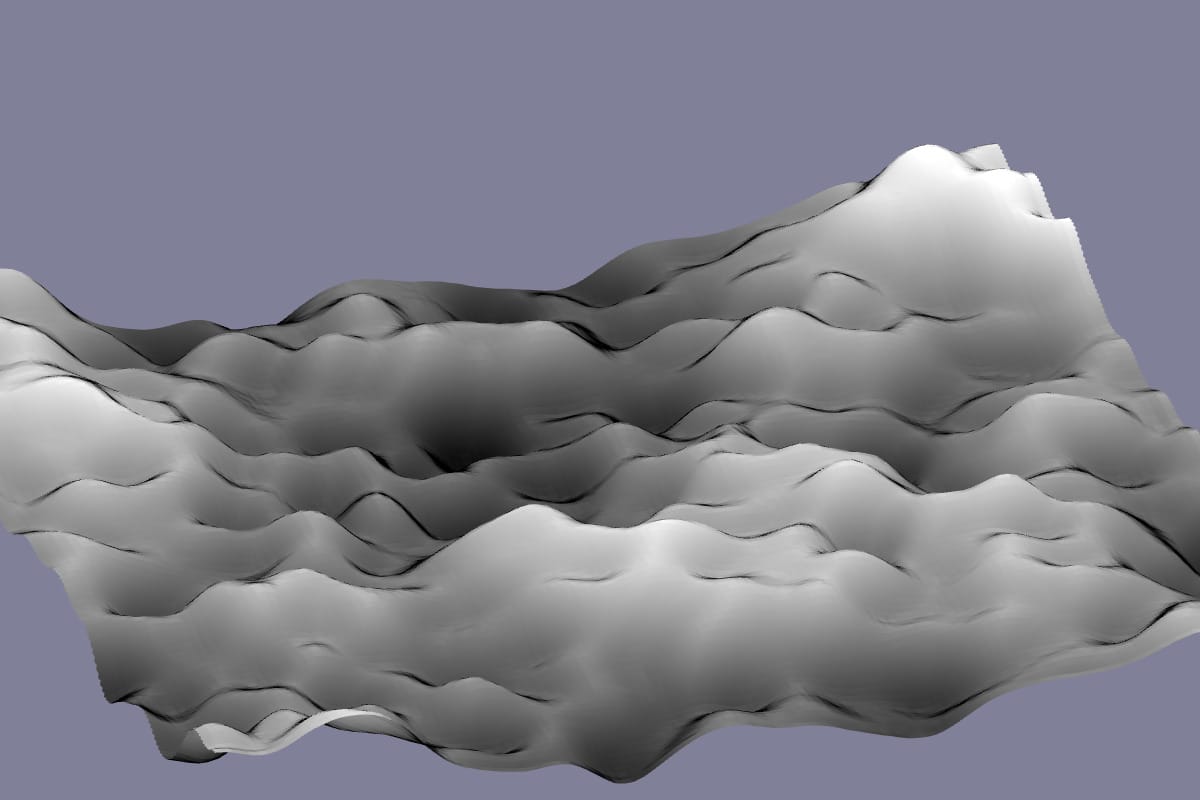
One of my goals for 2019 is to improve my existing pages. Yesterday I decided to work on my old 2D noise page. We normally use Perlin/Simplex noise to make terrain heightmaps, but on that page I used Fourier transforms instead. Perlin/Simplex noise are a fast approximation of the things you can get from Fourier transforms.

The 3D renderer on that page always bothered me. It was one of my early experiments with WebGL. I had never been able to figure out exactly what I didn't like or how to fix it.

I decided to improve the renderer.

I read through the code to and realized it was written so long ago that let and const weren't even widely available! I started by updating the code style to match the code I write today. I read through the rendering code and decided to switch from raw WebGL to regl.js, which lets me experiment and iterate much more quickly.

I wanted to compare the old and new output easily, so I put them side by side on the page. I wanted to try two techniques with the new renderer:

  1. Instead of building a new 3D quad mesh on the CPU every time the data changed, I built a single 2D triangle mesh with x,y, and then read the heightmap data from a texture on the GPU. Reading textures from vertex shaders is widely supported now. This way, I only have to update the texture on each render instead of rebuilding the mesh. Unfortunately I couldn't figure out why it wasn't interpolating pixels values; I had to put in my own interpolation.
  2. Instead of calculating normals and lighting on the CPU every frame, I calculated them in the fragment shader on the GPU. But I didn't want to use a standard lighting system; I wanted to apply outlines instead. I had learned how to do this in mapgen4 and wanted to try an even simpler approach here. This worked out really well.

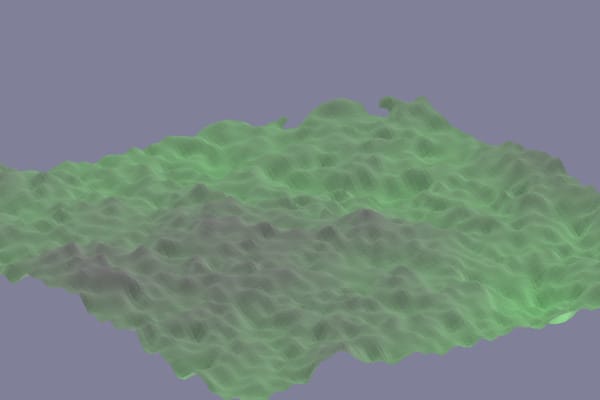
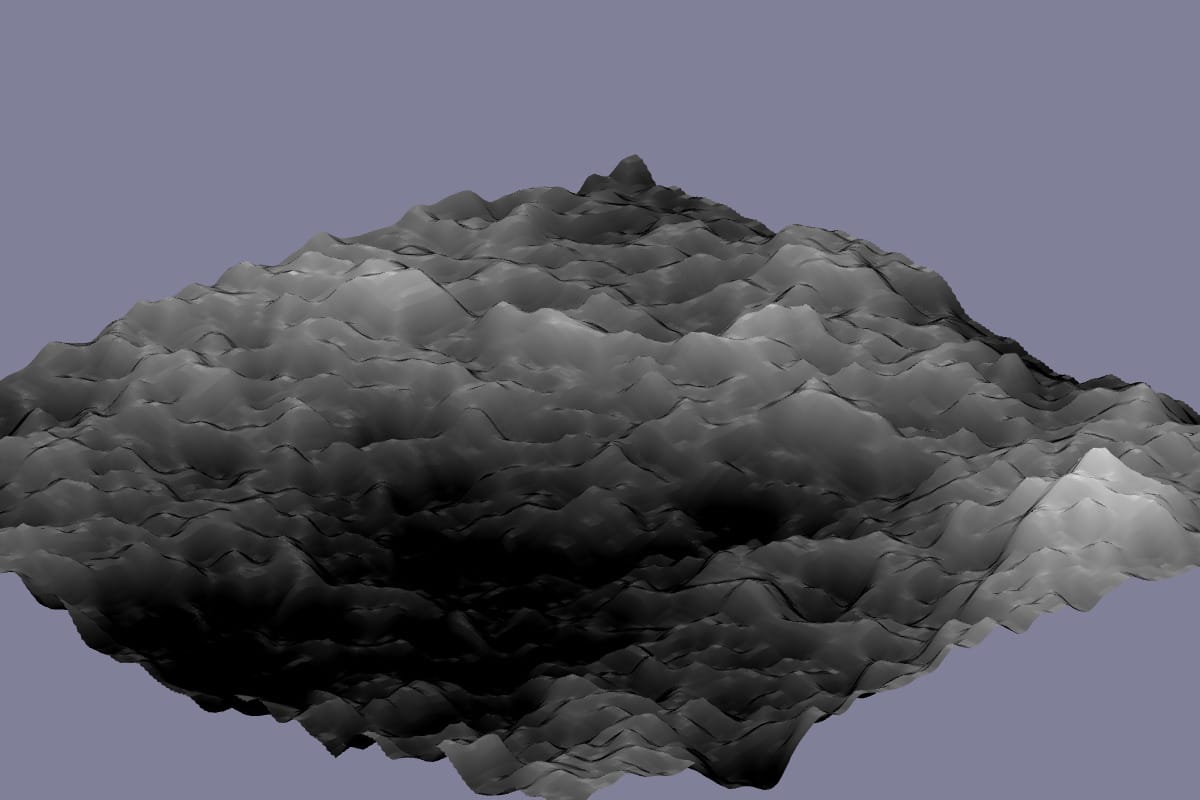
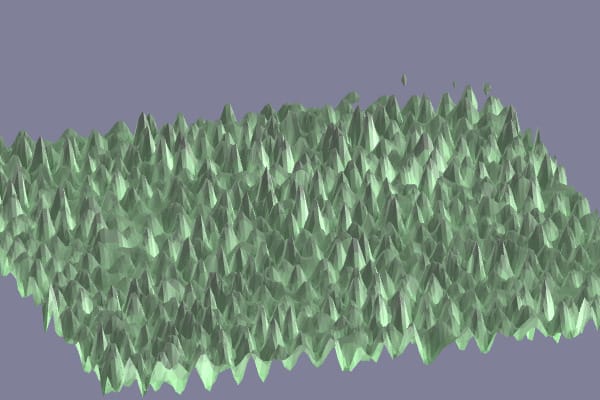
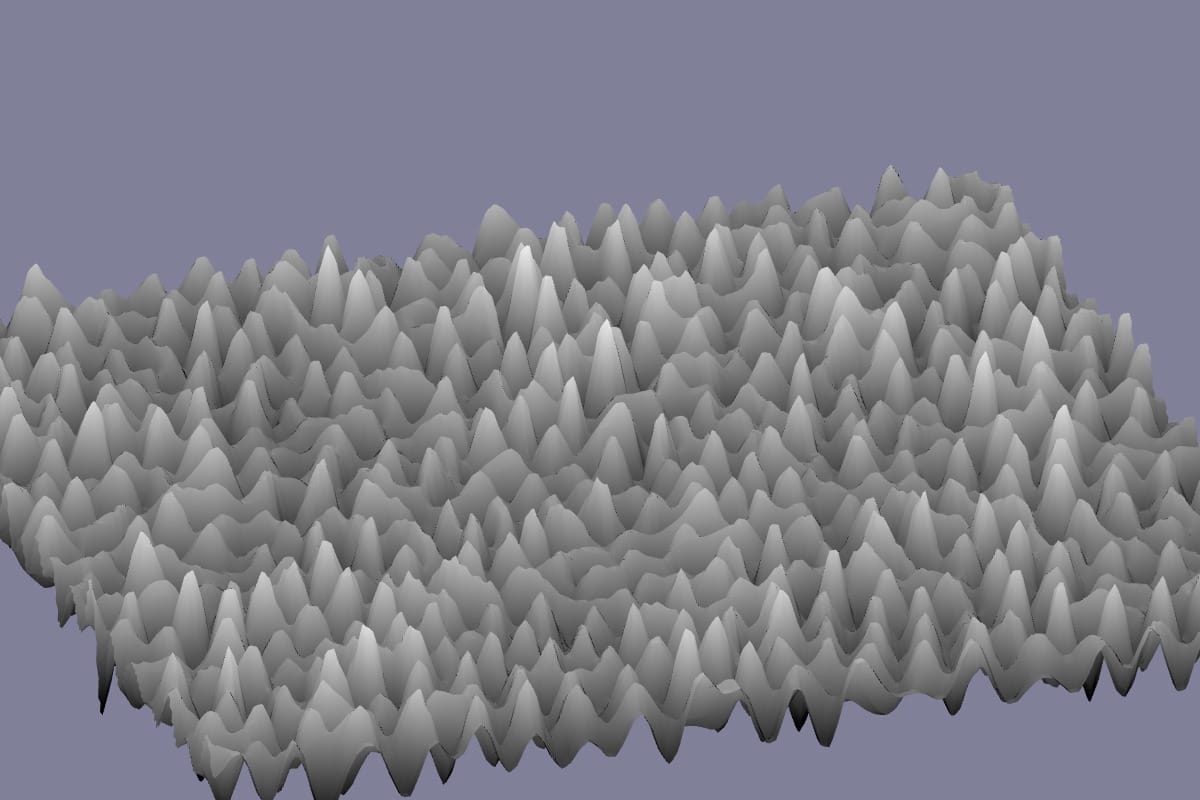
In this comparison you can see how the dark/light spots in the noise are renderered in the two renderers. With the old renderer (green) the color changes but the shapes are all mushy. With the new renderer (gray) the dark/light matches the noise, and the mountain peaks are easier to see.

2D noise values Old renderer New renderer
Landscape: old (green) and new (gray) renderer

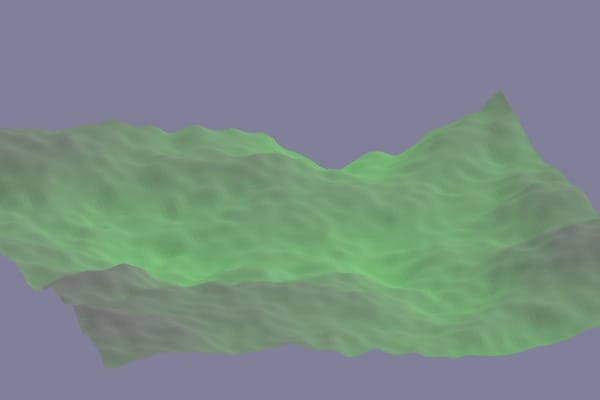
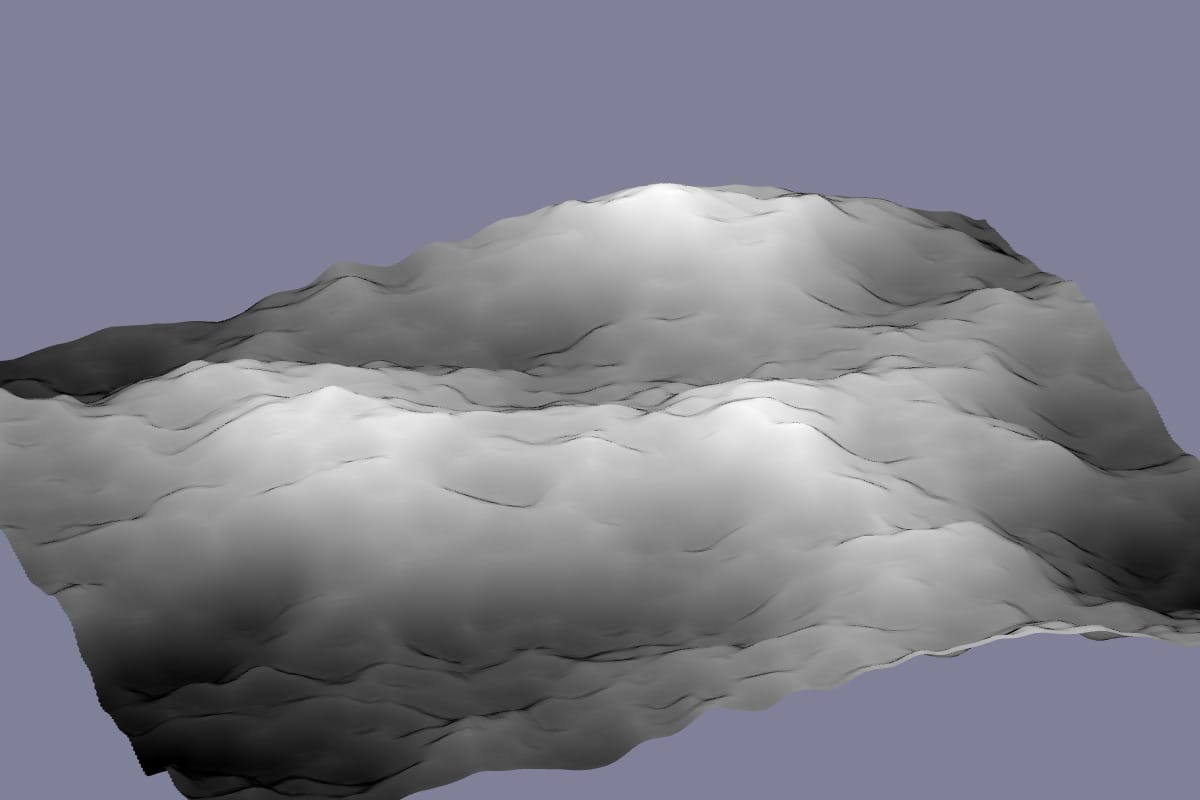
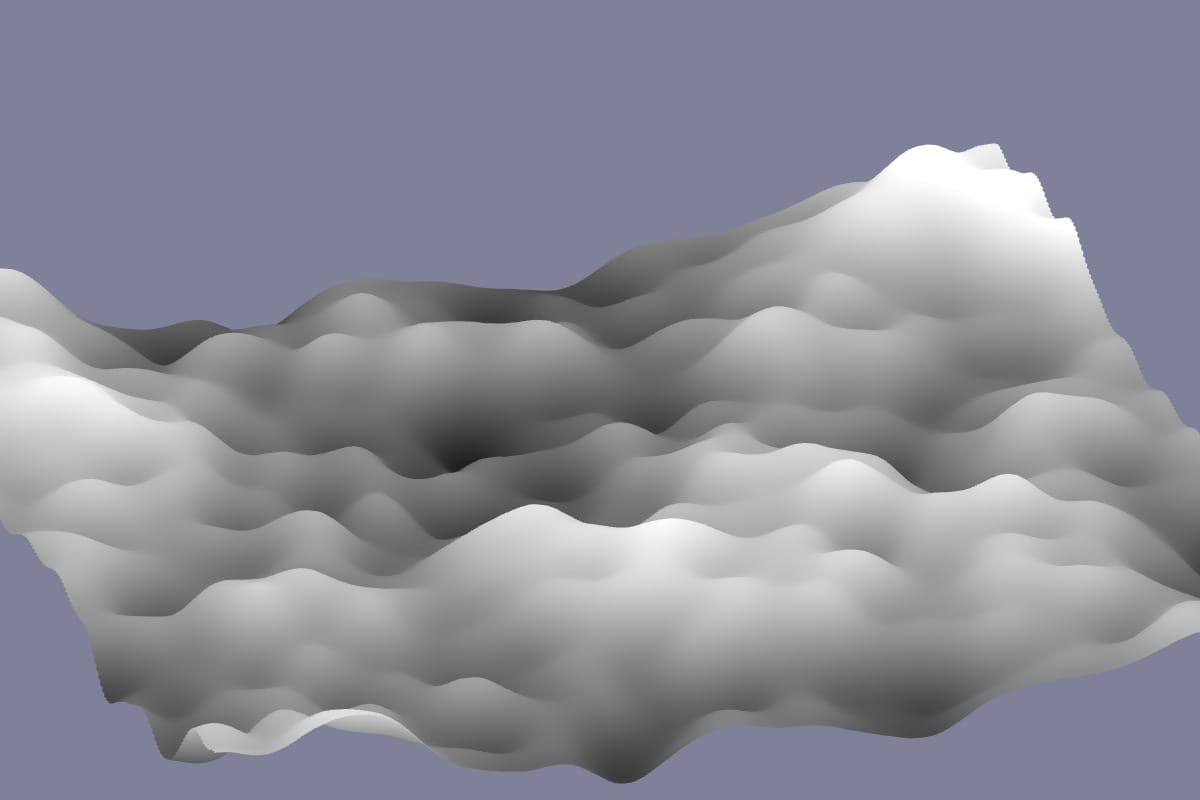
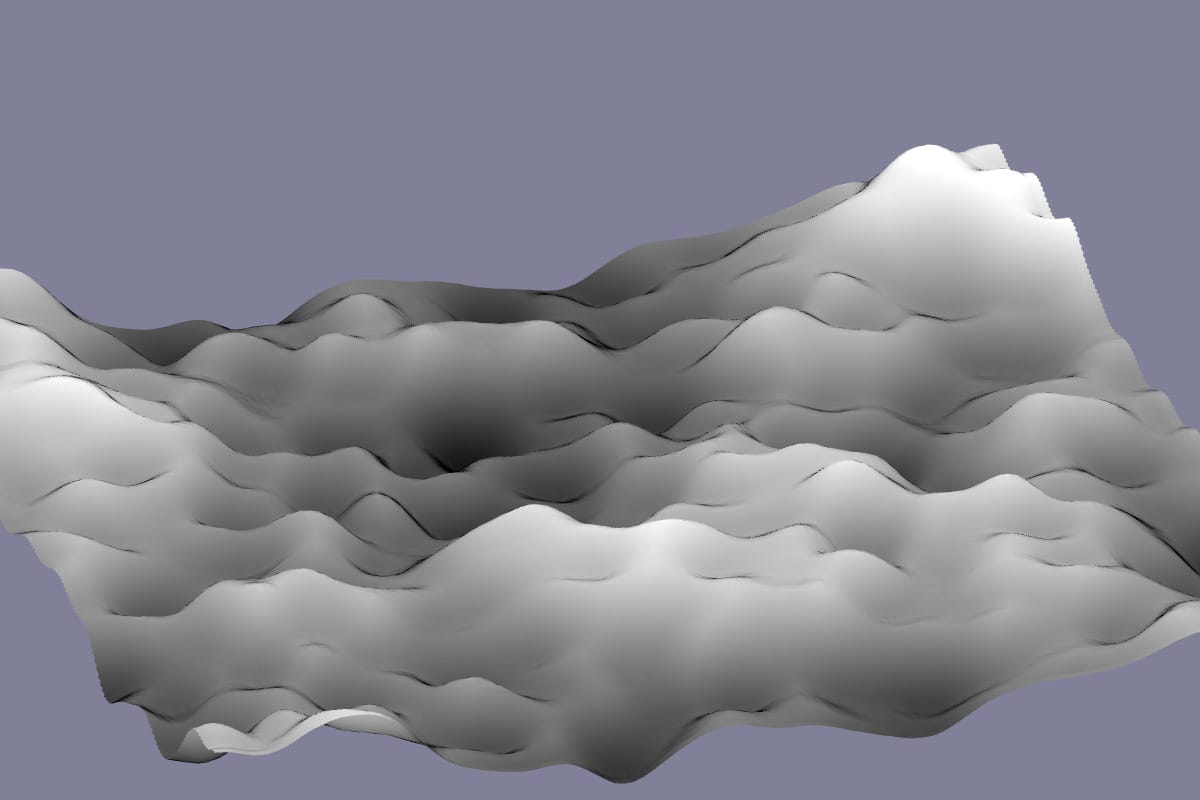
In smooth areas you can see how the outlines help show the shapes. You can also see that the old renderer flipped the elevation upside down (oops!).

2D noise values Old renderer New renderer
Smooth area: old (green) and new (gray) renderer

With blue noise (positive exponents) the new renderer looks much better:

2D noise values Old renderer New renderer
Blue noise: old (green) and new (gray) renderer

I'm really really happy with outlines! Compare:

No outlines Light outlines Medium outlines
Without and with outlines

The outlines are one line of code:

void main() {   float light = 0.1 + z - fwidth(z) * u_outline;   gl_FragColor = vec4(light, light, light, 1); } 

I darken the color based on fwidth(z). The GL extension OES_standard_derivatives calculates how much an expression changes from the current pixel(fragment) to adjacent pixels. When z changes a lot, that usually means it's changing from one mountain peak to another, so I darken the output color.

There are still more things I'd like to improve on this page, but the renderer was the thing that bothered me the most, and I'm now happy with it. The other changes will wait until another day.

Prototype Feast Or Famine

Ever since Corbin was born (last summer), I have felt like I've been in a relative famine with regards to playtesting (and gaming in general). I have tried to make up for that with online play at BoardGameArena.com, Boiteajeux.net, Yucata.de, etc.

In October, Michael was in town for Rincon, and I manages to get a couple of plays in with him. Then I sent 4 of my prototypes to Utah with him in hopes that they would get played in the TMG office.

Finally, after 8 or 9 months off, my playtesting group is back up and running again! This was great news, and it came just in time to finish up last minute development on Eminent Domain Origins, the reboot of my first game, Terra Prime.

Now that that's done however, I've run into a problem. All my prototypes are in Utah, what do I test next? Fortunately, I had something. TMG is doing a Deluxified version of Emperor's Choice (I'm in charge of the art direction and rules updating, like I did for Yokohama), and someone suggested we add a 2 player variant to that 3-5 player auction game. So I came up with something, and the last couple of weeks we've been testing that.

Yesterday, I came home to a box at my door containing my prototypes! They appear to be in fine condition, and now I've got the opposite problem: which of these should I test next?

* Crusaders: Divine Influence (expansion)
* Deities and Demigods (now Olympus on the Serengeti)
* Eminent Domain: Chaos Theory (dice game)
* Alter Ego
* Sails and Sorcery (Michael's mash-up of EmDo and El Grande)

In addition to that, pretty soon I'll have a version of Worker Learning to test as well!

Crusaders: Divine Influence (expansion)

Since Crusaders: Thy Will Be Done arrived a couple of months ago, it seems to be very well received. This makes a perfect window for a Deluxified expansion to go on Kickstarter, along with the opportunity to get the Deluxified base game again, later this year. In anticipation of this, I designed an expansion before my playtesting haiatus, and I'm pretty happy with it so far.
Divine Influence adds 4 new building tracks (16 more buildings per player), a revamped (more involved) Influence action, and a few new knight orders to go with them.

Olympus on the Serengeti (fka Deities and Demigods)

I posted before about the theme of Deities and Demigods changing to re-imagine Greek mythology in an animals of Africa setting. Art is underway on this one, and I'm a little worried how it will turn out. I think that, like Eminent Domain's title, when players see everything in context, it will work well.

This one doesn't really need more testing, unless I want to add that Hades module to the game.

Eminent Domain: Chaos Theory

Last I checked, with the final tweak to 5p (and maybe 4p) games (everyone starts with 1 tech advance), I think this one is ready to go. It is in line to get art done after the more pressing Divine Influence, which will start as soon as we wrap up art for Eminent Domain Origins which is happening right now (about a month late, which means it probably won't make GenCon, unfortunately).

Alter Ego

I finally hired an artist and a graphic designer for this age old prototype, though I haven't seen anything from them yet. The game could use some finishing touches, but nothing that would change the major art pieces, so I figured starting art would be ok. There's no deadlude for this one at the moment per se, so maybe starting art now will mean when it comes time, I'll actually make it for once!

Sails and Sorcery

Michael impressed me with the thoroughness he was putting into his mash-up of EmDo and El Grande when he talked about it on the TMG podcast. He didn't really have a title, so I made this one up for now. He didn't want to let me in on the game until he'd gotten it far enough along - perhaps for fear I'd sort of take over the design (that's kind if my MO). In October, he brought the game with him and we played a few times. I think it was an excellent start! He was ready to let me start doing my thing...

Right away I had a few course grained suggestions, some of which we implemented on the spot. Others Michael didn't necessarily agree with. He left the game with me to work on, but my testing was on hiatus at the time, so beyond editing the rules to include what I wanted to try, I wasn't able to do anything.

Come December, Michael was in town again for the holidays, and I sent his prototype back with him, with my rules edit inside, so they could try it in Utah. I don't think they ever got to it though.

Now that I'm playtesting again, I asked for this prototype back, so we could give it some plays.

Worker Learning

I think I've mentioned that I recruited my friend Rick to help co-design one of my more promising ideas. After some good discussion back and forth, some solo testing on his part, and a couple revisions of the prototype, Rick tells me this game just got its first live playtest! Sounds like it went well, and generated good feedback. Rick will be bringing an updated version to Gamestorm next weekend, and after incorporating that feedback, I'll make a prototype and bring it to my group.

I'm excited to see this game in action! But some of the others have a little higher priority, so it might be several weeks before I get to try this one.